
Passport Photo vs. Visa Photo: What Size Does Each Country Want?
U.S. passport and visa photos are both 2 x 2 inches, but most of the world uses 35 x 45 mm. A country-by-country size table, why one photo can't serve every application, and how to make each format correctly.
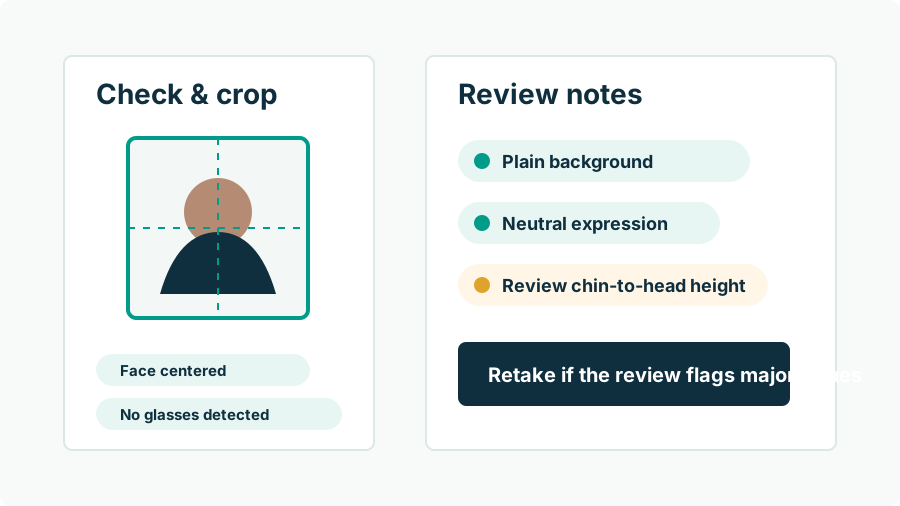
Are passport photos and visa photos the same thing?
They are the same genre — standardized identity photos — but not the same specification. For U.S. documents the answer is easy: the U.S. passport and the U.S. visa both use a 2 x 2 inch square with identical composition rules, so one compliant photo serves either application. Internationally the picture fragments: most countries specify a 35 x 45 mm rectangle for both their passports and their visas, several use their own sizes (China's 33 x 48 mm, for example), and digital submission systems add pixel-dimension requirements on top. So when someone asks whether their passport photo will work for a visa, the real question is which country's visa — and the answer lives in that country's official spec, not in any general rule.
What sizes do common destinations require?
| Document | Photo size | Shape |
|---|---|---|
| U.S. passport | 2 x 2 in (51 x 51 mm) | Square |
| U.S. visa | 2 x 2 in (51 x 51 mm) | Square |
| UK passport / visa | 35 x 45 mm | Rectangle |
| Schengen visa (EU) | 35 x 45 mm | Rectangle |
| Canada visa | 35 x 45 mm | Rectangle (Canadian passport photos are larger: 50 x 70 mm) |
| China visa | 33 x 48 mm | Rectangle |
| India visa | 2 x 2 in (51 x 51 mm) | Square |
| U.S. green card / USCIS forms | 2 x 2 in (51 x 51 mm) | Square |
Treat this table as orientation, not authority: requirements change, and head-size rules, background colors, and digital specs vary even among countries sharing a print size. Verify against the issuing government's website before you print or upload anything.
Why can't one photo serve every application?
Because the frame is only half the spec — the geometry inside it is the other half, and it doesn't transfer. The U.S. wants a 25–35 mm head in a 51 mm square (roughly 50–69% of frame height). Schengen rules want the face to occupy about 70–80% of a 45 mm-tall frame. China's 33 x 48 mm format defines its own chin-to-crown band. Crop a finished U.S. square down to 35 x 45 and the head usually lands too large and the proportions wrong; pad a 35 x 45 out to a square and the head is too small. Background rules diverge too — the U.S. requires white or off-white, while some Schengen countries prefer light gray. The workable habit: keep one wide, unedited original per person, and generate each country's format from that original on demand.
How do you produce each format correctly?
- Shoot one master photo — straight-on, neutral expression, plain light background, framed from mid-torso up with generous space around the head.
- Look up the official spec for each document you're applying for: print size, head-size range, background color, digital pixel requirements.
- Generate each crop from the master, never from another finished crop — the geometry needs the full original frame to work with.
- For prints, lay the crops on a 4 x 6 sheet and print at kiosk scale (see the printing guide); measure after printing.
- For digital submissions, export at the portal's required pixel dimensions from the sharp original — no screenshots, no recompressed copies.
Passport Photo AI currently automates the U.S. 2 x 2 workflow — crop, checks, print sheet — which also covers U.S. visa and USCIS photo geometry; for other countries, apply the same discipline against their published spec.
Do composition and editing rules differ between countries?
Less than sizes do. Nearly all national specs descend from ICAO's machine-readable travel document standards, so the core is remarkably uniform: recent photo (6 months is the common window), full-face frontal view, neutral expression with mouth closed, eyes open and unobstructed, no glasses in a growing number of countries (the U.S. since 2016), plain light background, even lighting, and an unretouched image. The differences are at the margins — background color preferences, whether a faint smile is tolerated, head-covering documentation. The no-editing principle is the most portable rule of all: an identity photo that has been beautified, filtered, or AI-modified defeats its purpose everywhere, and biometric matching systems at borders worldwide are the reason. If you keep one honest, unedited master photo, you are compliant in spirit everywhere and compliant in letter after a size check.
What about digital visa systems and photo uploads?
More visa processes are going digital, and each portal bolts pixel requirements onto the paper spec: the U.S. online passport renewal accepts JPG/JPEG/PNG/HEIC/HEIF files of 54 KB–10 MB; the U.S. visa (DS-160) system takes square digital photos with its own minimum resolution; other countries' e-visa portals define their own boxes to tick. Universal advice applies across all of them: upload a true camera original rather than a scan or photo-of-a-photo, keep compression minimal, and let the portal's own validation tool have the final word on technical fit. And treat every table like the one on this page — ours included — as a starting point: the embassy or immigration authority issuing your document publishes the binding spec, and five minutes on their site beats a rejection letter every time.
FAQ
Is a U.S. visa photo the same size as a U.S. passport photo?
Yes — both use the 2 x 2 inch (51 x 51 mm) square with the head measuring 1 to 1 3/8 inches, and both follow the same background, expression, and no-editing rules. A photo that meets the passport spec meets the U.S. visa spec.
What photo size do most other countries use?
35 x 45 mm is the closest thing to an international default — the UK, the Schengen area, Canada (for visas), Australia, and many others use it or something near it. The U.S. 2 x 2 square is the outlier.
Can I crop my U.S. 2 x 2 photo down to 35 x 45 mm?
Usually not well. Head-size rules differ by country, and a square crop rarely contains the right proportions for a taller rectangle. Regenerate each format from the original wide shot instead of recropping a finished crop.
Where do I find the official spec for a visa photo?
The embassy, consulate, or immigration website of the country issuing the visa — sizes and rules change, and third-party tables (including this one) are informational summaries, not the authority.
Do other countries also ban edited photos?
Broadly yes. Identity photo standards worldwide derive from the same ICAO principles: accurate, recent, unretouched likeness, plain background, neutral expression. Assume no beautification or AI editing is acceptable anywhere unless the issuing authority says otherwise.
How Passport Photo AI helps
Passport Photo AI turns an everyday photo into a passport-style crop or print sheet. It centers the face, sizes the head to the official 2 x 2 geometry, flags likely compliance problems like shadows or tilt, and exports both a digital square and a 4 x 6 print layout. It does not alter your appearance in the submission workflow, and the final decision always belongs to the passport agency or acceptance facility — verify your photo against the official requirements before you submit it.