
How Recent Does a Passport Photo Need to Be?
The six-month rule explained: why you can't reuse your old passport's photo, what counts as a significant appearance change, and how date problems get caught during review.
What is the six-month rule?
Every U.S. passport photo — printed for a DS-11 or uploaded for online renewal — must have been "taken in the last 6 months." The purpose is straightforward: the photo becomes the government's reference likeness of you for up to ten years, so it needs to start as current as reasonably possible. Six months is the standardized compromise between freshness and practicality, and it appears with the same force in the digital upload rules. Note the direction of the window: it counts backward from when you submit, not from when you started thinking about applying. A photo taken seven months ago fails even if it's flattering, sharp, and perfectly composed — recency is a threshold requirement, not a quality judgment.
Why can't you reuse your old passport's photo?
Because it flunks the recency rule by definition — a renewal happens ten years (or five, for childhood passports) after the original photo was taken — and because the mechanics of reuse violate other rules besides. To reuse an old photo you'd have to photograph or scan the print in your passport, and the digital upload guidance explicitly prohibits photos of photos and scanned prints as a quality matter. The same logic bars re-submitting the exact photo from a recent visa application if it has aged past six months. The State Department wants a fresh capture each cycle: you at your current age, hairline, and face, recorded directly by a camera. It is mildly annoying and completely reasonable — the entire value of the document depends on the photo matching the person holding it.
Which situations pass the recency test — and which don't?
| Scenario | OK to submit? |
|---|---|
| Photo taken this month for this application | Yes — the ideal case |
| Photo taken 4 months ago, appearance unchanged | Yes — inside the window |
| Photo taken 8 months ago, appearance unchanged | No — outside the window regardless of likeness |
| Photo from your current (expiring) passport | No — years old, and a scan of a print besides |
| Photo from last year's visa application | Only if still within 6 months of this submission |
| Recent photo, but major surgery since it was taken | No — it no longer reflects current appearance |
| Old favorite photo "refreshed" with editing | No — fails recency and the no-editing rules at once |
What counts as a significant appearance change?
The six-month window assumes ordinary life; the current-appearance principle handles the exceptions. Routine drift — new hair color or length, growing or shaving a beard, normal aging, weight fluctuation, everyday makeup — doesn't invalidate a photo within the window, and doesn't require replacing an issued passport either. Significant transformation is different: major facial surgery, substantial trauma affecting facial features, or a gender transition that changes how you present are situations where a within-window photo can still fail the deeper requirement that the photo look like you now — and where holders of valid passports often apply for replacements so border checks go smoothly. The test is practical, not legalistic: would an officer comparing the photo to your face reasonably hesitate? If yes, take a new photo, whatever the calendar says.
How do date problems get caught?
More ways than people expect. Digital uploads can carry capture-date metadata, and the State Department's automated photo check plus human reviewers evaluate every submission — a photo that is visibly a scan of an old print (paper texture, print dots, the exact image in your previous passport) is an easy flag, and the digital rules prohibit photo-of-photo sources outright. Age mismatch is the blunter detector: a renewal application from a 45-year-old with a photo of a 35-year-old doesn't need forensics. And enforcement has a long tail — the photo that slips through review still has to match your face at airport counters for the next decade, which is where an outdated likeness extracts its real price in secondary screening and awkward questions. The recency rule is one of the cheapest rules to simply follow.
What's the smart timing workflow?
- Take the photo the same week you apply. Recency guaranteed, current appearance guaranteed, nothing to track.
- Shoot it yourself at home — a plain wall and ten minutes — so "getting the photo" never becomes the errand that delays the application past someone else's schedule.
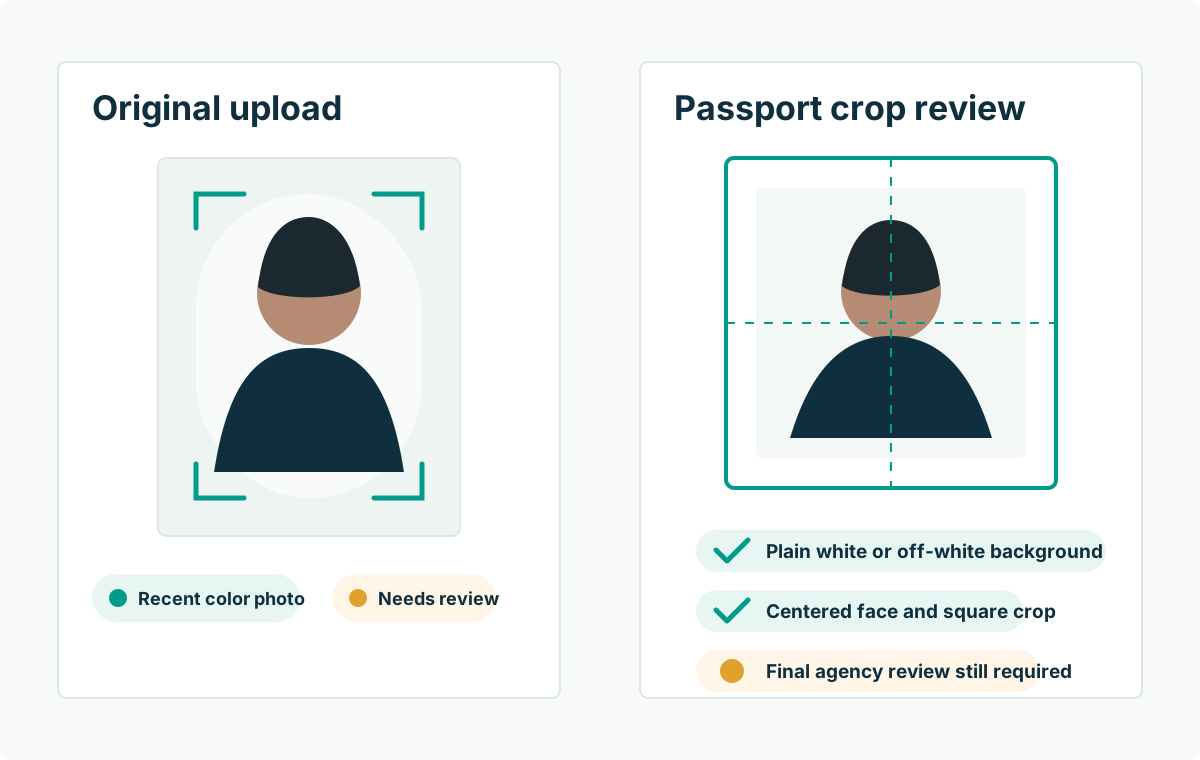
- Format immediately: build the 2 x 2 crop and print sheet, or the digital square for online renewal, from the fresh original. Passport Photo AI handles the geometry and flags composition problems the same day.
- Keep the untouched original file with its metadata intact — it documents the capture date if anything is questioned.
- If the application stalls past six months (life happens), reshoot before submitting rather than gambling — the reshoot costs ten minutes, the rejection costs weeks.
Fresh, honest, and formatted to spec: the photo becomes the easiest part of the application instead of the reason it bounces. Final verification against the official checklist stays with you, as it should.
FAQ
How old can a passport photo be?
Six months, maximum. The photo must have been taken within the six months before you submit the application, and it must reflect your current appearance.
Can I reuse the photo from my current passport when renewing?
No. Your existing passport photo is by definition years old, and renewals require a new photo taken within the last six months. Submitting a copy of the old one is a stated rejection reason.
Can I use nice photos I had taken last year?
Not if they're older than six months at submission time — even if you look identical. Reviewers can't verify your unchanged appearance from the file alone, so the recency window is enforced as a hard rule.
Do I need a new passport if I change my appearance after it's issued?
Routine changes — hair color, beards, aging, glasses on or off in daily life — don't require a new passport. Significant transformations, such as major facial surgery, can warrant applying for a replacement so the photo still matches you.
How would anyone know when my photo was taken?
Directly, through file metadata on digital uploads and visible cues (season, age, print wear); indirectly, because an outdated photo won't match how you look at later checks. Guessing at enforcement is the wrong game — a fresh photo costs minutes.
Should I take the photo before or after starting my application?
As close to submission as practical. Taking it the same week you apply guarantees recency, matches your current look, and removes a whole category of problems for the price of a ten-minute session.
How Passport Photo AI helps
Passport Photo AI turns an everyday photo into a passport-style crop or print sheet. It centers the face, sizes the head to the official 2 x 2 geometry, flags likely compliance problems like shadows or tilt, and exports both a digital square and a 4 x 6 print layout. It does not alter your appearance in the submission workflow, and the final decision always belongs to the passport agency or acceptance facility — verify your photo against the official requirements before you submit it.